
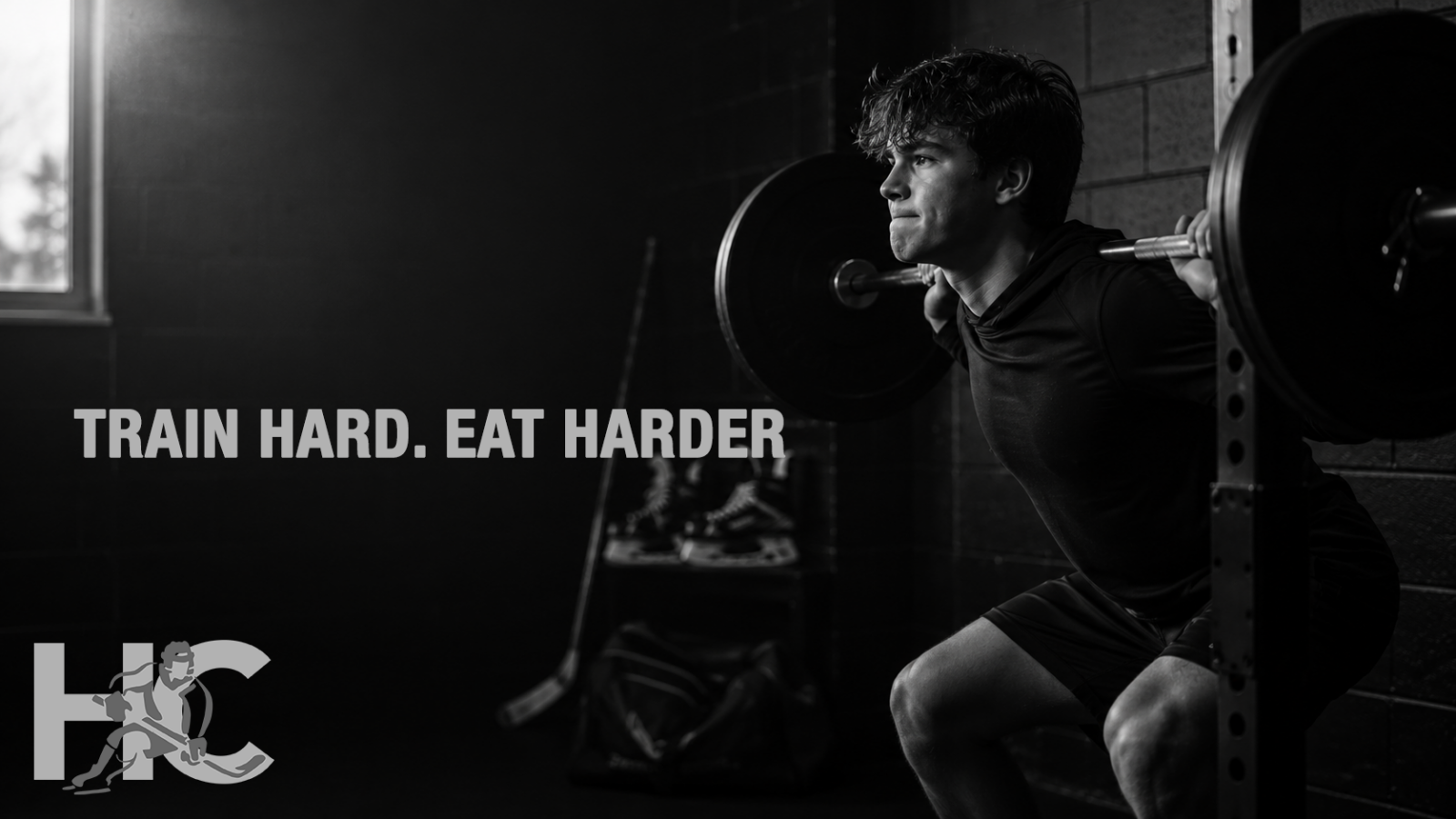
Every spring the same thing happens. The season ends, players take a couple of weeks off — which is fine, they need it — and then the off-season just kind of happens to them. A few skates here, some gym time when they feel like it, maybe a workout plan from a coach that gets followed for two weeks and then quietly abandoned.
Then August shows up, and for most players, it wasn’t enough. The difference between the player who comes back to camp visibly stronger and the one who looks the same as he did in April usually isn’t talent. It’s whether the summer had a real plan behind it — and whether that plan included how the player was eating, not just how he was training.
Why the Off-Season Decides What Camp Looks Like
Coaches don’t need tryouts to figure out who put in real work over the summer. They can see it in the first week of camp — who’s still standing up straight in the third period of a scrimmage, who’s first off the line in a battle drill, who looks like a different player than the one who left in the spring.
That gap gets built in June and July, not in August. A player chasing a roster spot at the USHL, NAHL, BCHL, or CHL level, a prep tryout, or a bigger role on next year’s team is competing against players who treated the off-season as training time, not downtime.
Training Without Fuel Is Wasted Work
Here’s the part most off-season plans skip entirely: nutrition. A player can follow a well-built strength and conditioning program to the letter and still fall short of what it should produce, because the body doesn’t adapt to hard training without the right fuel behind it.
This isn’t about strict diets or counting every gram. It’s the basics done consistently: enough protein relative to bodyweight to actually build and repair muscle, the right kind of fuel in the hour or two before a hard session, a real recovery meal in the window after training instead of whatever’s around, and enough water and electrolytes to support two-a-days in summer heat. Skip that piece and a player is training hard and recovering poorly — which shows up as fatigue, stalled strength gains, and a higher injury risk right when the volume is highest.
What a Complete Off-Season Plan Actually Includes
A real off-season system has three parts working together, not a workout plan floating on its own.
| Component | What It Covers | Why It Matters |
|---|---|---|
| Structured Training | A written, progressive plan across the full off-season — strength, speed, conditioning, and change of direction, with built-in deload weeks | Progressive overload only works if the load actually progresses week to week; a random mix of workouts doesn’t build anything on purpose |
| Nutrition Plan | Pre- and post-workout fueling, daily protein and hydration targets, and a plan that shifts as training phases shift | Training builds the stimulus; nutrition is what turns that stimulus into strength, speed, and recovery |
| Progress Tracking | A log of sessions, loads, and benchmarks from the start of the summer to the end | Players who track their work stay honest about consistency and can see concrete proof of progress, which keeps motivation up in week eight |
This is exactly the structure behind the 12-week system we built for hockey players, which pairs the training program with a hockey-specific nutrition guide and performance journal — built around the actual demands of the game rather than a generic plan with a hockey label on it.
Common Questions From Hockey Families
How many days a week should a player actually train in the off-season?
Most well-built programs land around five sessions a week — a mix of lifting, speed work, and conditioning — with recovery and deload weeks built in every four to five weeks. More isn’t automatically better; a plan without recovery built in tends to break players down instead of building them up.
Does a 14-year-old really need to think about protein targets and hydration?
Not with the precision of a pro athlete, but yes, in general terms. A growing teenager training hard five days a week needs meaningfully more protein and fluid than a sedentary peer, and most young players — and their families — simply haven’t been told what that looks like in practical terms.
My player already has a team-issued summer workout. Is that enough?
Sometimes. The question to ask is whether it’s actually progressive — does the load or intensity change from week to week — and whether it includes any nutrition guidance at all. A lot of team-issued plans are a solid list of exercises with no periodization and no fueling plan behind them, which leaves half the equation unaddressed.
What if we can’t afford a personal trainer or a dietitian?
A one-on-one trainer isn’t the only path to a structured plan. A well-designed, hockey-specific written program — training and nutrition together — can get a motivated player most of the way there without the cost of individual coaching, as long as the plan itself is built correctly and the player actually follows it.
Red Flags in an Off-Season Plan
- No progression built in. If week one and week ten look identical, the plan isn’t actually training anything — it’s just repetition.
- No deload or recovery weeks. Constant maximal effort without planned recovery is how players show up to camp fatigued or hurt instead of sharp.
- Generic, not hockey-specific. A bodybuilding split or a general youth fitness plan doesn’t train the movements — first-step quickness, change of direction, repeated-sprint conditioning — that actually show up on the ice.
- Nutrition left out entirely. A plan that only addresses the gym side is missing the piece that determines whether the training actually gets absorbed.
- No way to track progress. Without a log or benchmarks, neither the player nor the family has a real answer for whether the summer worked.
The Bottom Line
A good off-season isn’t about doing more — it’s about doing the right things, in the right order, with fueling that actually supports the work. Structured training, a real nutrition plan, and a way to track progress are the three pieces that separate a summer that shows up in October from one that quietly evaporates. If you’re building that plan for your player this summer, our 12-week off-season training and nutrition system lays out exactly that structure, week by week.
Schedule a complimentary consultation to discuss where your player is and what the road ahead looks like. No obligation — just an honest conversation.
Schedule a Free Consultation