
Junior hockey is the bridge between youth hockey and the next stage of a player’s career, but “junior hockey” isn’t one thing. Families researching the path forward run into four major leagues, each with a different structure, level of competition, and relationship to NCAA and NHL eligibility. The decision got more complicated in 2025, when the NCAA reopened the door to CHL players. Here’s how to think about each path.
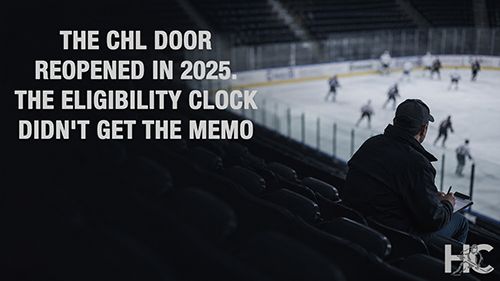
Since 2020, the CHL had been off the table for any player who wanted to preserve NCAA eligibility. That changed when the NCAA voted to allow CHL players to compete in Division I hockey starting August 1, 2025. It’s a real option again — but the fine print matters, and it interacts directly with the new NCAA eligibility rules families are already navigating.
The Four Leagues at a Glance
| League | Classification | Typical Ages | Pay Structure | Primary Pathway |
|---|---|---|---|---|
| USHL | Tier I Junior A (USA) | 16–20, skews 18–20 | Amateur — no player pay | Top NCAA D1 feeder in the U.S. |
| NAHL | Tier II Junior A (USA) | 16–20, skews older | Amateur — no player pay | Broad NCAA D1/D3 pipeline |
| BCHL | Junior A, independent (Canada) | 16–20 | Amateur — no player pay | Strong NCAA D1 pipeline, especially West Coast |
| CHL (OHL/WHL/QMJHL) | Major Junior (Canada) | 16–20 | Stipend for necessary expenses | Top NHL Draft pipeline; NCAA D1 eligible as of Aug. 2025 |
USHL — The NCAA D1 Pipeline
The USHL is widely regarded as the top junior league in the United States for players targeting NCAA Division I hockey. It’s a 16-team league, entry is through the USHL Draft or free-agent tender, and it does not charge players to play. The tradeoff is scarcity — roster spots are genuinely competitive.
NAHL — The Broader Net
The NAHL sits one tier below the USHL, with roughly double the teams spread across a wider footprint — more roster spots, which makes it a realistic entry point for players who need another year of development before USHL-level competition makes sense.
BCHL — Canada’s USHL Equivalent
The British Columbia Hockey League is the closest Canadian equivalent to the USHL and has built one of the strongest NCAA commitment records of any junior league on either side of the border since leaving the CJHL and Hockey Canada in 2021 to operate independently.
CHL — Major Junior and the New NCAA Door
The CHL — the umbrella for the OHL, WHL, and QMJHL — is the largest and most established development league in the hockey world, historically the single biggest pipeline to the NHL Draft. In November 2024, the NCAA Division I Council voted to make CHL players eligible for Division I hockey effective August 1, 2025, provided their compensation is limited to necessary expenses.
What the Rule Does Not Do: the eligibility change applies to Division I only — CHL players are still not eligible for Division III. And every year spent in the CHL still runs against a player’s NCAA eligibility clock under the incoming 5-for-5 rule. We cover the mechanics of that rule in detail in The NCAA 5-for-5 Rule: What Hockey Families Need to Know Right Now.
Which League Fits Which Player?
The NHL-Draft-First Player
If the primary goal is maximizing NHL Draft position and exposure, the CHL remains the deepest and most heavily scouted development environment available.
The D1-Track Player Who Wants the Widest Runway
For a player targeting NCAA D1 hockey who wants to preserve the most eligibility, the USHL (or BCHL, geography depending) remains the more direct route.
The Player Who Needs More Time
A player who isn’t yet USHL- or BCHL-caliber but has clearly outgrown youth or prep hockey is often best served by the NAHL.
The West Coast or Pac-Program-Bound Player
For families targeting western NCAA programs specifically, the BCHL’s track record and travel logistics often make it the more sensible choice.
The Player Considering Both CHL and NCAA
This profile most needs a specific, individualized eligibility plan before committing to anything.
Questions to Ask Before Committing to Any Junior League
- What is the realistic path to meaningful ice time in year one, not just a roster spot?
- How does the coaching staff describe your player’s specific role and development plan?
- How many players from this program advanced to your player’s stated goal in each of the last three years? Ask for names.
- What does the billet or housing situation look like?
- How does this league or team affect NCAA eligibility timing given your player’s specific birth year?
- What is the actual travel and school-balance picture across a full season?
The Bottom Line
There is no single “best” junior league — only the league that best fits a specific player’s timeline, goals, and current level of readiness. Get the eligibility mechanics right before you commit to a league, not after.
Schedule a complimentary consultation to discuss where your player is and what the road ahead looks like. No obligation — just an honest conversation.
Schedule a Free Consultation