
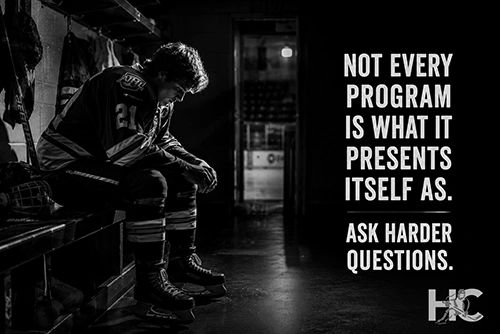
Not every junior hockey program is what it presents itself as. Some are built on hype, financial incentives, and promises that never materialize. Choosing the wrong program can cost a player a full season of development — and in some cases, real money and real opportunity. This guide covers what to watch for before you commit.
Why This Matters More Than Families Realize
Choosing a junior hockey program is one of the highest-stakes decisions a hockey family makes. You are entrusting your player’s development to a coaching staff and organization for a full season, often moving your player away from home, and spending significant money to do it.
A good junior program should feel clear, stable, honest, and development-focused. If the situation feels confusing early in the process, it almost never becomes simpler once you have committed.
The Red Flags
Red Flag 1 — Grand Promises About Ice Time and Exposure
A coach or program director will praise your player’s skills and make confident promises about top-line ice time and guaranteed exposure to NCAA or professional scouts. What to know: promises are not guarantees. Be wary of any program that sells the dream without talking about their process or coaching philosophy.
Red Flag 2 — High-Pressure Signing Tactics
“I need a commitment by the end of the weekend or the offer is gone.” These tactics create a false sense of urgency. What to know: a program that genuinely wants your player will give you a reasonable amount of time to make the right decision.
Red Flag 3 — Unclear or Hidden Costs
Some programs present a team fee upfront that is just the beginning; unexpected costs appear later. What to know: request a complete, itemized breakdown of all potential costs for the full season in writing.
Red Flag 4 — Tryout Camps with No Real Openings
Some programs run large tryout camps that generate revenue from fees while having little genuine intention of taking most attendees. What to know: ask how many players from last year’s camp made the opening-night roster.
Red Flag 5 — No Clear Role for Your Player
If a coaching staff cannot clearly explain where your player fits on the team, that vagueness is a problem. What to know: ask directly what success looks like for your player in year one.
Red Flag 6 — All Exposure, No Development
Programs that talk exclusively about scouts and exposure but have little to say about coaching quality or player improvement are prioritizing the wrong things. What to know: ask about the coaching staff’s backgrounds and practice-to-game ratio.
Red Flag 7 — Vague Billet Arrangements
For players moving away from home, the billet situation is critical. What to know: ask how the billet matching process works and what happens if a placement isn’t working.
Red Flag 8 — Can’t Explain Where Players Go Next
A strong junior program has a track record they can name specifically. What to know: ask for a list of recent college commitments, then verify them independently.
Red Flag 9 — Coaching or Organizational Instability
High turnover in coaching staff or frequent roster upheaval are signs of underlying problems. What to know: ask how long the current head coach has been with the program.
Red Flag 10 — What Current Players and Families Tell You
Talk to current players and families independently — not the ones the program offers as references. What to know: one dissatisfied family is an outlier; a pattern across several is a verdict.
Questions to Ask Before You Commit
- How many roster spots are genuinely open, and how do you determine that number?
- Where does this player fit on this team, and what does their role look like in year one?
- Can you provide a complete, itemized breakdown of all costs for the full season in writing?
- How long has the current coaching staff been with the program?
- How does your billet matching process work?
- What is your practice-to-game ratio?
- How many players committed to college programs in the last two years, and at what levels?
- Can I speak independently with two or three current players or their families?
- What does your contract say about refunds if circumstances change?
Signs of a Strong Program
- Clear, specific answers to direct questions — no deflection
- Honest about competition for ice time and what earning a role requires
- Transparent about all costs upfront and in writing
- Stable coaching staff with clear development philosophy
- Verifiable track record of player advancement to college programs
- Organized, thoughtful billet program with family support structures
- Current players and families who speak positively without being prompted
- Gives families reasonable time to make the right decision
The Bottom Line
The junior hockey landscape includes genuinely excellent programs that change players’ trajectories — and programs that collect fees, overpromise, and underdeliver. Your player’s development window is finite. A season in the wrong environment is a season that doesn’t come back.
Schedule a complimentary consultation to discuss where your player is and what the road ahead looks like. No obligation — just an honest conversation.
Schedule a Free Consultation