
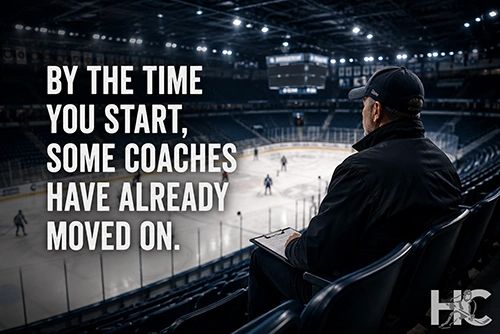
Most families start thinking about college recruiting too late. By the time they realize the process has started, some of the most important windows have already closed. Here’s the timeline that actually matters — and what your family should be doing at each stage.
The Short Answer: Earlier Than You Think
College hockey recruiting has moved earlier over the past decade. Division I programs at the top of the landscape are identifying players during their U16 and U17 years, and in some cases earlier. By the time a player is a senior in high school, many schools have already filled the majority of their pipeline for that birth year.
Being on a coach’s radar and receiving an offer are two different things. The process of getting on that radar starts much earlier than most families assume.
The Recruiting Timeline by Stage
| Ages | Stage & What’s Happening |
|---|---|
| 13–14 | Foundation Stage. No recruiting contact is permitted. The focus should be entirely on development — skating, skill, compete level, and hockey IQ. |
| 15–16 | Identification Stage. Division I programs begin tracking players in earnest. Players at high-profile U16 tournaments and showcases are being seen — whether they know it or not. |
| 16–18 | Active Recruiting Stage. Official contact between coaches and prospects begins. Campus visits, phone calls, and formal offers happen during this window. |
| Junior Hockey | Development and Visibility Bridge. USHL, NAHL, BCHL, and other leagues serve as both a development environment and a showcase for uncommitted players. |
What “Being on a Coach’s Radar” Actually Means
Families often confuse visibility with recruitment. Being seen at a showcase does not mean being recruited. Getting on a coach’s radar requires being in the right environments consistently — not just appearing at one event and hoping for the best.
The Role of Junior Hockey in the Process
Junior hockey is not a fallback — it is often the bridge. Many of the best college hockey players spent two or three years in junior leagues before committing.
The Biggest Timing Mistakes Families Make
- Starting too late. Assuming the process begins in a player’s junior or senior year of high school misses the identification window entirely at many programs.
- Focusing on the wrong events. Not every showcase is on every coach’s calendar.
- Chasing the wrong tier. Families who only target D1 programs often overlook D3 programs at excellent academic institutions that could be a better fit.
- Letting the player be passive. Proactive, well-timed communication from a player carries real weight.
- Assuming development will take care of itself. Programs are recruiting what a player will be at 20, not just what he is at 16.
What Families Should Be Doing Right Now
The right actions depend on where your player is in the timeline. But across every stage, the fundamentals are the same: focus on development first, understand which environments provide the right visibility, build relationships with programs the right way, and make decisions based on fit rather than name recognition.
Schedule a complimentary consultation to discuss where your player is and what the road ahead looks like. No obligation — just an honest conversation.
Schedule a Free Consultation